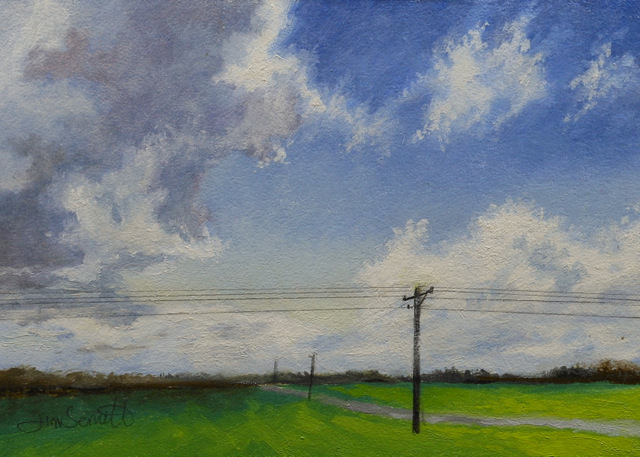
You can watch amazing cloud formations along the
Mississippi River bottoms, there are some very nice long vistas to view the clouds roll in from the Southwest.
Mississippi Thunderhead - Cloud Forms III, 5 x 7 inches,
oil on panel, Jim Serrett
The lazy days of summer, watching clouds build up on the
horizon.
Forming big, billowing mushrooming thunder heads.
Thunderhead: a rounded mass of cumulus or cumulonimbus
cloud often appearing before a thunderstorm.
Cloud Forms II, oil on panel, 5 x 7 inches, Jim Serrett
I really enjoy the long views and vistas during this part of the season. Just so many subtle colors, and when the light hits it, a nice glow. I attempted to capture that glow in this small color sketch.
From my painting excursions into the Illinois river bottoms
along the Mississippi, visits along the Ohio in Paducah, KY and to our recent
trip to Cape Girardeau, Missouri. I have been told that one who spends his leisure
time on or along a river is called a River Rat. I’ve been called worse things.
The name Mississippi is derived from the Native American
peoples Ojibwe word "Misi-ziibi," meaning "Great River".
The longest river in North America, it is the third longest
river in the world at nearly 2,400 miles. It reaches from the Canadian border
and empties into the Gulf of Mexico. The Mississippi River is an important area
of the wet lands with a massive ecosystem and environment that covers ten
states, two Canadian provenience's and creates the third largest water shed in
the world.
The Mississippi River has been a focal point in American
history, from Native American tribes who flourished along its banks, through European explorers, the American Civil War, the Great Mississippi Flood of
1927.
Western settlers and traders called it the “wall” because
of the difficulty of crossing her, it being the biggest barrier to western expansion.
For decades man has tried to tame her.
This has been a busy spring, lots of art activities going
on, exhibitions and shows in several local communities which I am participating
in. So it’s been a lot of framing and organizing of work, between that and the
turbulent weather we are having here, there has not been much brush time.
Did get this little study done, I like these long views across the plowed fields, very typical Southern Illinois scenery this time of
year. It is also a pretty good metaphor for me to keep in mind, when placing
your work out there to exhibit you need to see the long view. Like
everybody else I get impatient about the goals I want to achieve, I tell myself
my skills need to be at this level, my sales at that and so on and on. The reality is that with all of this stuff, - the
journey to success is not a sprint, but a marathon.
Nearly all of my work begins with some type of preliminary
sketch, either a thumbnail drawing in a sketchbook or oil study in my Pochade
Box. Lately I have been spending a great deal of time sketching, gathering
information outdoors and drawing from my imagination. Creating small rough
abstract sketches to work out composition and design elements.
Mainly I am using pen and ink with watercolor. I like the
ink because you don’t fiddle with it as much as say a pencil sketch, you just
have to lay it down with some speed and confidence. It is very permanent mark
making and you simply/humbly live with what you put down and move along. Over
that I wash in some color, do some crosshatching and try to capture the value
and mass pattern. I call them my scribbles; and that is what they are, quick
notations of design ideas based on nature.
They are exercises in capturing what I see in front of me
from direct observation (the Art of Seeing) but also it is about the simple
pleasure of drawing.
I look for a strong arrangement of dark and light patterns,
the Japanese use the word Notan which means the "dark-light"
harmony. But a notan is also as much
about shape/form, positive/negative, figure/ground relationships. It is why it
is such a strong abstract design tool. I like to think of it as being the
ying-yang of composition. Ever walk into a gallery full of art and be
instantly attracted to a particular piece, drawn to it from across the room?
Our eyes are drawn to the strong arrangements of shapes and patterns. As
you learn to use this design tool you will recognize it in paintings and
drawings of master artists.
Slow down mentally and take a long look at your subject,
carefully choose the center of interest or theme of the piece, what it is
about, what has drawn you to this motif and design outwards from that point.
Simplify and edit down the elements by making them subordinate to that central
idea. That is the key to good composition.
It is fun working out compositions and concepts, playing
with the elements and ideas based on the anatomy of the landscape. Let them
evolve and "brainstorm" many studies, before you know it you will
have sketchbooks full of Composition Thumbnails which are a library of knowledge
and imagination to work from.
“Even in front of nature one must compose.” ~ Edgar Degas
Color Studies:
Last Light, oil on panel, 8 x 10 in, Jim Serrett
Over the Horizon, oil on panel, 8 x 10 in, Jim Serrett
I cannot think of a time when I did not find clouds fascinating, as a kid I could spend hours finding images in them. Many lazy summer days were spent laying on the backyard lawn looking for a triceratops or a pirate ship. Today, I admit they still occupy hours of my imagination.
Now I am a bit more analytical about clouds, certainly more interested in their formation and pattern then what animal or thing I see in them. The type of cloud is important, I make an attempt to name them cumulus, stratus or cirrus. I feel that if the naturalistic observation is truthful, then it is easier to express what you see, think and feel about what is in front of you.
If I study the clouds with that intent - the personality of them tends to come forward. It’s funny how they can be like lead actors in a drama, for they set the mood and temperament. They can be broody or cheerful, dramatic or calm, the entire passing attitude of a day or painting can be changed by a cloud.
These particular clouds had a stillness and mesmerizing silence to them, their shadows moved across the lake in a medley of patterns like a liquid kaleidoscope. Time seemed to slow or even move backwards somehow, I became closer to that little boy laying in the lawn looking for a triceratops or a pirate ship.
"What amazes me about landscape, landscape recalls you
into a mindful mode of stillness, solitude, and silence where you can truly
receive time." - John O'Donohue
Pareidolia ( parr-i-doh-lee-ə) is a psychological phenomenon involving a stimulus (an image or a sound) wherein the mind perceives a familiar pattern of something where none actually exists
The weather this summer has been a bear, just too wet and too dang hot. So my long list of projects only has a few items checked off. The old fence will have to hang on one more winter. We did get in some kayaking and some plein air painting but mostly I did a great deal of sketching. Floating and bobbing around in my kayak with a watercolor kit is a pretty interesting thing to do and a fun way to spend a day.
The piece above was done in the studio based on a series of sketches from the lake. We have probably kayaked around this point a couple of dozen times and have I sketched it undoubtedly as many. So I started this painting with a particular image in mind about this place and the feeling I wanted it to convey.
To help create a sense of depth and light I worked into glazes of oil color. Pushing and pulling the light effect and hopefully captured the end of a perfect day.
This is a pastoral scene I trek through several times a
month. During the summer there always seems to be a flotilla of clouds sailing slowly
across the sky. When I think of the dog days of summer this image always comes
to my mind.
I really wanted to capture that summer atmosphere and
felt that a studio piece was the best way to do that. I created the painting from a pochade study, some watercolor sketches and my memories of this place.
One of the characteristics of oil painting I enjoy most
is the ability to create transparent, semi-transparent and opaque layers of
paint. Manipulating those qualities can give an image a lot of texture and depth.
I like the variation of greens you get with glazes and scumbling effects. You
start playing around with the color green differently when you work in thin
layers and use it to unify passages. Building up paint in layers
of glazes and scumbles provides a arsenal of effects that can create atmosphere
in a landscape painting.
Sketchbook watercolor study.
Sketchbook thumbnails.
I truly enjoy working through an idea with the process of
creating thumbnails and roughs. Relying on observations made over time and my
memory of the place, it becomes layers of thought, that for me, reach a
higher level of understanding and refinement.
Here we are at the end of
my 30 in 30-day painting challenge and I have got to say that it zoomed by, I must
have had fun.
I enjoyed exploring
composition and colors with these alla-prima paintings. From the beginning I
intended to concentrate on design and composition but as I reflect over the collection
I started to see an unexpected story being told. As I was looking at the big
forms in nature, a theme quickly
evolved that was about earth and sky and water. Lots of weather effects,
dramatic skies, sunsets and clouds, the forces of nature. So I was happy that they collectively
communicated the spirit of the natural world.
My approach was to be as
direct and complete with my brush as I could and record the motif in front of
me. The goal was to make quick and spontaneous decisions, describing things
simply and abstractly. Yet hang onto that illusion of real space and place and
the experience of it. I find myself looking a lot at the Barbizon painters, Charles-Francois
Daubigny and Jean Baptiste Camille Corot and the Russian School of the late nineteenth century Isaac Levitan and Ilya
Repin. These painters handle the sense
of space so masterfully, so much abstraction in their work, brush handling, surfaces
and texture. They could just drag the viewer into the atmosphere of the
painting
Anyway this is where my
head has been during this endeavor. Looking for insight from artist of the past
and observing the world for inspiration.