Tuesday, January 22, 2013

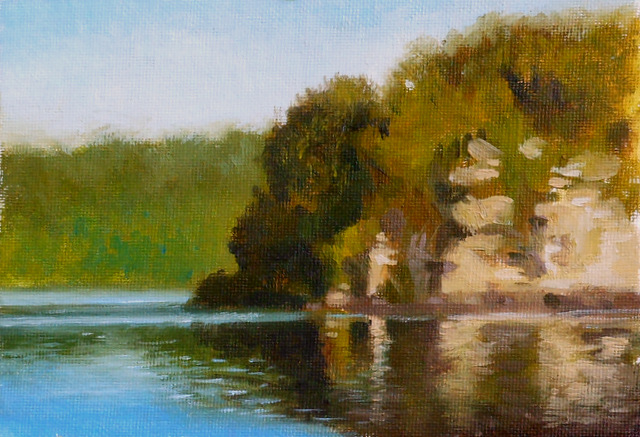
Sycamore on Frozen Lake


With cabin fever setting in, and a small break in the weather, we needed a hike at Murphysboro Lake State Park. Even though most of the snow was gone many of the park roads were still closed, I am guessing until things thaw out from our big freeze.


“A lot of people like snow. 
I find it to be an unnecessary freezing of water.”
                                                                           - Carl Reiner


There are several large sycamores on the lake that are very unique in their appearance. With the variations of white, brown and gray on the bark and the enormous reach of the branches they are majestic trees towering along the shoreline. Against the cold winter sky and frozen lake this tree really was the perfect subject.
Hopefully I captured some of her majesty between shivers.


I frequently tramped eight or ten miles through the deepest snow to keep an appointment with a beech-tree, or a yellow birch, or an old acquaintance among the pines.
                                                                                  -  Henry David Thoreau 


Detail - Sycamore on Frozen lake - Oil on panel
Original full painting  9"x 12"


Explore - Question - Learn - - Enjoy, Jim


Sunday, December 30, 2012

Thanks for Listening III


As another year closes I want to express, to all of you, my heart felt appreciation. Thank you for your support and encouragement, it's been a great year.

And to my loving wife, Linda there is no words that can express my appreciation and love for you. Happy Anniversary.

So, I'll finish this thought with these fine words...

To laugh often and much;
to win the respect of intelligent people
and the affection of children;
to earn the appreciation of honest critics
and endure the betrayal of false friends;
to appreciate beauty; to find the best in others;
to leave the world a bit better
whether by a healthy child, a garden patch,
or a redeemed social condition;
to know even one life has breathed easier because
you have lived.
This is to have succeeded.

                                         ----Ralph Waldo Emerson


Happy New Year !

Explore - Question - Learn - - Enjoy, Jim

Saturday, December 22, 2012

Apocalyptic Sunset


Still here, a great sunset however
Oil on panel, 5x7 inches


Explore - Question - Learn - - Enjoy, Jim


Friday, November 30, 2012

On Location with William R. Leigh


William R. Leigh (1866-1955) Leigh created hundreds of paintings of the West. A highly trained and skilled artist, he earned the title of the Sagebrush Rembrandt for his meticulous attention to detail, painstaking draftsmanship, skillful rendering of dazzling light, and unorthodox use of vivid color. Painting from life, in some of the most formidable terrains Leigh wanted to capture the disappearing western landscape.

It's been noted that he never went anywhere with out a sketch box and would do numerous studies of any theme that interested him. His travels lead him to Africa to create plein air paintings of the Serengeti Plains that would serve as the basis of dioramas at the American Museum of Natural History in New York


Northern Waso Nyiro Waterhole  Oil on canvas panel, 12 x 16


Now I know I have dealt with bugs, gnats and other buzzing biting things. Even the unwanted interruptions of fellow humans, but never have felt the need for armed protection while I painted.

Leigh was an extraordinary artist who would fearlessly go anywhere for inspiration.
He lived an amazing adventurous life and was a true artist.


 Explore - Question - Learn - - Enjoy, Jim


The Outdoor Studies of William R. Leigh
Hunt, David C., “W. R. Leigh: A Painter in Africa,” in William R. Leigh: African Landscapes
Gerald Peters Gallery, New York, 1998.
Natural History, African Number, Journal of the American Museum of Natural History, November-December 1927.
Tillenius, Clarence, “African Scenes by William R. Leigh: The Explorers Journal, Volume 65 Number 2, June 1987.


Saturday, October 27, 2012

Garden Study - Japanese Anemone


Anemone hupehensis var. japonica

Painting directly from nature has a transcendent effect on a person. The physical act of sketching outdoors and dealing with all of nature’s elements forces you to truly engage with her. You are in the elements; you feel the sun, hear the wind and smell the subject. It all assists in your attempt to capture the essence or spirit of a place. You see it and feel it, it is like painting a portrait of a hug.


Click Here to join the auction.

The season is starting to change and all around me nature is transforming into her fall colors, the normal subject of my outdoor work this time of year. However I could not pass up these Japanese Anemones, blooming conveniently in the garden just out my studio door. To make sense of all of the visual confusion I really had to choose what was essential. My brushwork is more gestural and laid down fairly quickly and simply. I wanted to capture that experience not just a moment in time.


We have to teach our eyes to look at nature, and there are many of us who have never seen it and never will.
                                                                                    — Jean-Baptiste-Siméon Chardin


Explore - Question - Learn - - Enjoy, Jim


Sunday, September 30, 2012

Gray Scale – Value finder – Color Isolator

Make a quick and easy Gray Scale, Value Finder, Color Isolator for painting en plein air.


A gray scale is a must have tool for any paint box. You can put one in each of your paint kits and have several around the studio like I do. Determining value is the first step in both composition and color mixing. So, as you look at a potential scene it is best to start your design by thinking about the tonal pattern and that it is the organization of light and dark which creates the illusion of space and depth


These scales are simply made from color charts found at the local paint store. The higher end stores have a better selection; charts shown here from Sherwin-Williams. I prefer the warm gray scale which is closer to the gray mix I actually use, made from ivory black and umber.


I use a simple single hole paper punch and create a viewing aperture. Holding the value scale up to your subject, you can isolate the local color and get a more accurate reading.
You can see more precisely the color bias of a hue, the direction it leans on the color wheel either towards warm or cool. And by moving the finder back and forth locates its value and intensity.


I like these charts because they really are disposable, the value scales I made with oil colors I am a little more protective of and keep in the studio. On these Gray Scales I can place dabs of color and do physical comparisons. I use the single color chips which are a mid gray (around a value five on the Munsell scale) also, to really target a color and isolate a color note. Punch a few holes in the isolator and you can relate and compare several color notes in your composition at once. I once made these color isolators out of peoples business cards but I don’t seem to get them anymore plus it was always hard to contact someone after punched with holes and dabbed with paint.


Just a couple notes; a value scale from 0 to 10 is preferred and more common, but you can use anything from an 8 to even a 12. It really doesn't matter because in the aperture, you are looking for the least amount of contrast, you may never actually match the exact value in the isolator but it will give you direction to tweak your color mixture. These charts are missing pure white and pure black; well, you can judge that with out literally having that in your hand. Once you locate the darkest dark and lightest light in your painting you have established your tonal range. Then use this as a tool to help you judge those value relationships and analyze by comparison, degrees of contrast. I have learn so much by using grey scales in the field and observing value in nature. With a sketchbook thumbnail, some color chips and this field study I have more than enough resources and information to re-create the inspiration onto a later larger studio work.


Sunset Study, oil on panel, 5x7 


It is in the contrast of light and dark that design happens.
                                                                                                                      Helen Van Wyk


In an observed color, value can be very hard to see. And although the two are inseparable in painting you can be way off with a hue but not with a value when painting form.
It is finding the pattern of light and dark that creates interest and strong design and it is in the tonal structure of lights, halftones and shadows that we create depth and describe form. So when it comes down to the components of color, that being hue, value and chroma, collectively referred to as a color note, value is the most difficult and is the most critical.


I recommend that you go for the proper value first, even if it is at the expense of your color. Once you have the proper value you can "inject" the color. 


Links:
Munsell Color System  Here’s How Munsell Color Theory Works…
Stapleton Kearns Blog


Thursday, August 30, 2012

Kayak En Plein Air Painting


Painting from a Kayak with a Cigar Box – Pochade Box


 “Life is a journey, not a destination.”
                                                                               ― Ralph Waldo Emerson

No saying could be any truer when it comes to painting on location in a kayak.
For several years, a favorite weekly escape for Linda and I has been exploring the lakes, streams and water ways of Southern Illinois by kayak. This has been the inspiration of many of my works. 


I have always been drawn to nature; I could never describe in words the peace and calm I gain when hiking or kayaking and just the sheer amazement I find in a natural wild place. There is something about being in nature that makes one live in the present.


And for that reason, I feel when painting plein air landscapes you have to try and capture that sense of place. You may just be painting light, color and shape, but what you are really painting is an experience. That is the language of art.


Our equipment for this outing is pretty simple, a couple of kayaks, a cooler with drinks and food, swim suits and a Cigar Box Pochade with a hand held umbrella for painting in the shade. 


Linda’s boat is a 14 foot Perception Spectrum, a great kayak with a foot controlled surf rudder which is both nimble and stable in the choppiest waters. She’s been paddling this boat for nearly fifteen years, just shows the quality of this vintage girl. (Girls?)  My kayak is a 15 foot Dagger Charleston, on flat water lakes this boat is a rocket. Both boats are touring kayaks with plenty of storage in compartment bulkheads and hatches for long day expeditions or weekend paddling and camping.


I use the umbrella so I can create shade and have equal light on my palette and canvas. Judging colors in direct sunlight is next to impossible; your colors will be overly saturated and you will constantly be compensating for the sun glaring on your painting and into your eyes. I call this retina melt down.


But somewhere during our adventure Linda decided to turn my painting session into a sailing session. It was pretty impressive that even in a light wind she was able to get a lot of speed by catching the current of air at different angles. I think we are going to have to keep one of these in both boats.


"Do not go where the path may lead, 
go instead where there is no path and leave a trail."
                                                                                              --- Ralph Waldo Emerson


All three works are oil on panel, 5x7" and available in my Etsy Store. 
The little Cigar Box Pochade is after the design I featured here in an earlier article.


Explore - Question - Learn - Enjoy, Jim


Tuesday, July 31, 2012

The Bombay Sunshade or the modern MacGyver facsimile.


In this heat getting out of the sun is important to anyone attempting to paint en plein air on a 100 degree day. Finding a shady spot is always a good answer and having one of those cute little umbrella attached to my tripod might be even better. But when the shade keeps moving and there is no umbrella salesman near by, improvise!


And just like MacGyver, that resourceful secret agent with an encyclopedic knowledge of science, able to solve complex problems with everyday materials he finds at hand, along with his ever-present duct tape and Swiss Army knife, I sprung into action.
Binder clips, car window shade and wam-bam, instant shade and sun block!


With my MacGyver Shade I was able to finish my 8x10 oil sketch with out melting a retina.
I wanted to focus on just the color of the water, attempting to capture the interesting color notes formed by the setting sun. Most of this sketch was done with a painting knife.


At home I thought the auto shade was a pretty good idea, certainly lightweight enough to stuff in a backpack, but the idea needed a bit of tweaking. So I pulled out one of my reference books, The Encyclopaedia of Oil Painting  ( I am sure MacGyver/Richard Dean Anderson owned this book ) and there it was The "Bombay" Sunshade.
Just proves that good ideas repeat themselves and that our artistic ancestors had, and have a wealth of knowledge to share. The woman seems a little warm in her outfit but look at that clamp mechanism, and those ribs in the bonnet. So I'm thinking backpacker tent poles, maybe even the rain-fly, a three way C-clamp or even a picture framers miter clamp, along with my ever-present duct tape and Swiss Army knife.............


"Necessity is the mother of invention"
                                                                                                      Plato


Explore - Question - Learn - Enjoy - Jim

Encyclopedia of Oil Painting, Fredrick Palmer
North Light, Cincinnati,Ohio1983


Saturday, June 30, 2012

Edgar Payne: The Scenic Journey Documentary


Edgar Payne Sunset, Canyon de Chelly Oil on canvas, c. 1916

This upcoming special will profile the life of American landscape painter Edgar Payne.
EDGAR PAYNE: THE SCENIC JOURNEY, will follow Payne from his childhood in the Ozark
Mountains, through his years in Chicago, and on to his discovery of the California landscape that became his lifelong inspiration. Local producer/director Joshua V. Hassel and writer/narrator Michael Paglia are creating the film in association with the Pasadena Museum of California Art, and with the curators and scholars behind the touring exhibition of the same name.


Watch Edgar Payne: The Scenic Journey on PBS. See more from KBDI


The trailer for the documentary has some great images of Payne at work in the studio and on location. It alone offers some interesting insight into the artists work and methods, can not imagine what more may be in the full length footage. Mark your calendar.


Exhibition and touring retrospectives of Edgar Payne
The first major exhibition of his work in over forty years, The Scenic Journey traces Payne’s artistic development as he traveled the world and features over 100 objects, from paintings and drawings to photographs and studio artifacts.


Edgar Payne The Rendezvous (Santa Cruz Island, CA) Oil on canvas, 1915 

Pasadena Museum of California Art
Pasadena Museum of California Art (June 3 - October 14, 2012) 
Gilcrease Museum (December 1, 2012 - March 24, 2013)


Edgar Payne, San Gabriel Valley 

Edgar Payne: The Scenic Journey catalog can be purchased online.
Released in conjunction with the traveling exhibition organized by the Pasadena Museum of California Art, Edgar Payne: The Scenic Journey, presents more than 125 reproductions of Payne's paintings, drawings, and decorative arts, as well as rarely seen photographs from the artist's travels and selections from his personal collection of compositional studies


Explore - Question - Learn - Enjoy, Jim Serrett

Wednesday, May 30, 2012

Serrett Box - Pochade Box by Fran Chuba


Fran Chuba is an artist from California USA, who sent me some amazing photos of her pochade box. She has some unique and well thought out customization's to the Serrett Box Design. What I really like is her simple method of carrying a wet panel in the lid, everything I've seen up to date has been too complicated or is just not functional. I have a converted cigar box which holds a wet sketch and have always liked that when done,  I just close the box and walk away with it. This design is truly is a kit for on the go painting.

"You'll also see in my photos that I made an additional wood palette that slips between the 2 "covers". This acts as an additional paint mixing surface, and as a divider when I close my easel, with the wet canvas board still stuck to the back wall of the easel lid, to protect the wet canvas board from the paint mixtures below. I'll flip the extra paint mixing surface over so the clean side will be against the wet canvas board (though it will not touch), and the wet side will be against the other paint mixing area."


The wet panel solution is beautifully simple and I think you will see many people mimic Frans design. She made four boxes to accommodate specific panel sizes.

"I made 4 Serrett Pochade boxes. (2-9x12 boxes; 1-10x13 box; 1-11x14 box) Because my plan is to use only 6x8 or 8x10 or 9x12 canvas boards, and because I have never had difficulty keeping them in place with large squares of  UHU tac removable Adhesive Putty,
 I did not make the cuts in the back panel and use a bungy cord."


She finished her kit with a closure clasp, a side brush holder and neutral plexiglass palette. This following image is of the complete box sitting on a mini tripod. Fran figured that her cost per box was a little over 20 USD each, but keep in mind she built four at a time. One has to admit, it is a pretty impressive looking DIY kit, very professional, probably why her art group has asked if she might build more.


"My entire goal was simplicity.
I kept asking myself how I could do it "lighter" and "simpler".
Having a Yarka, an EasyL Versa, and a French Half-box - yet still searching for something "lighter" and "simpler" has been interesting."


"I made this because I like to do 10-15 mile hikes around the streets of San Francisco, stop and paint. The Serrett Pochade Box will be lighter, more compact, more efficient than anything I have. And, yes, like most artists I have several wonderful easels, including a Yarka Plein Air Easel and an EasyL Versa Plein Air Easel, I think this Serrett Easel will be the best of all! Thanks for your generosity for posting your directions on the internet for all of us to enjoy and use."
Fran Chuba

You can see Frans work on her website.


My original intent was to design a kit anyone could build with simple tools and materials.
I never thought about how creative people would elaborate on and contribute to that idea; it has been a great experience for me. Thank you for sharing your creativity.


Explore - Question - Learn - Enjoy, Jim


You can find the original Serrett Box post and plans here.